The Mohs Scale – Understanding Gemstone Hardness
The term ‘Mohs Scale’ may be something you’ve heard of, or it may be something completely new to you. Either way, understanding what it is and what it refers to in the gemological world is important.
Why? Because it can influence the gemstones you choose, the type of jewellery you wear, and even how those stones should be set.
So what is the Mohs Scale?
The scale was established in 1812 by the German geologist Friedrich Mohs. It is a qualitative scale that measures mineral hardness, from 1 (softest, talc) to 10 (hardest, diamond).
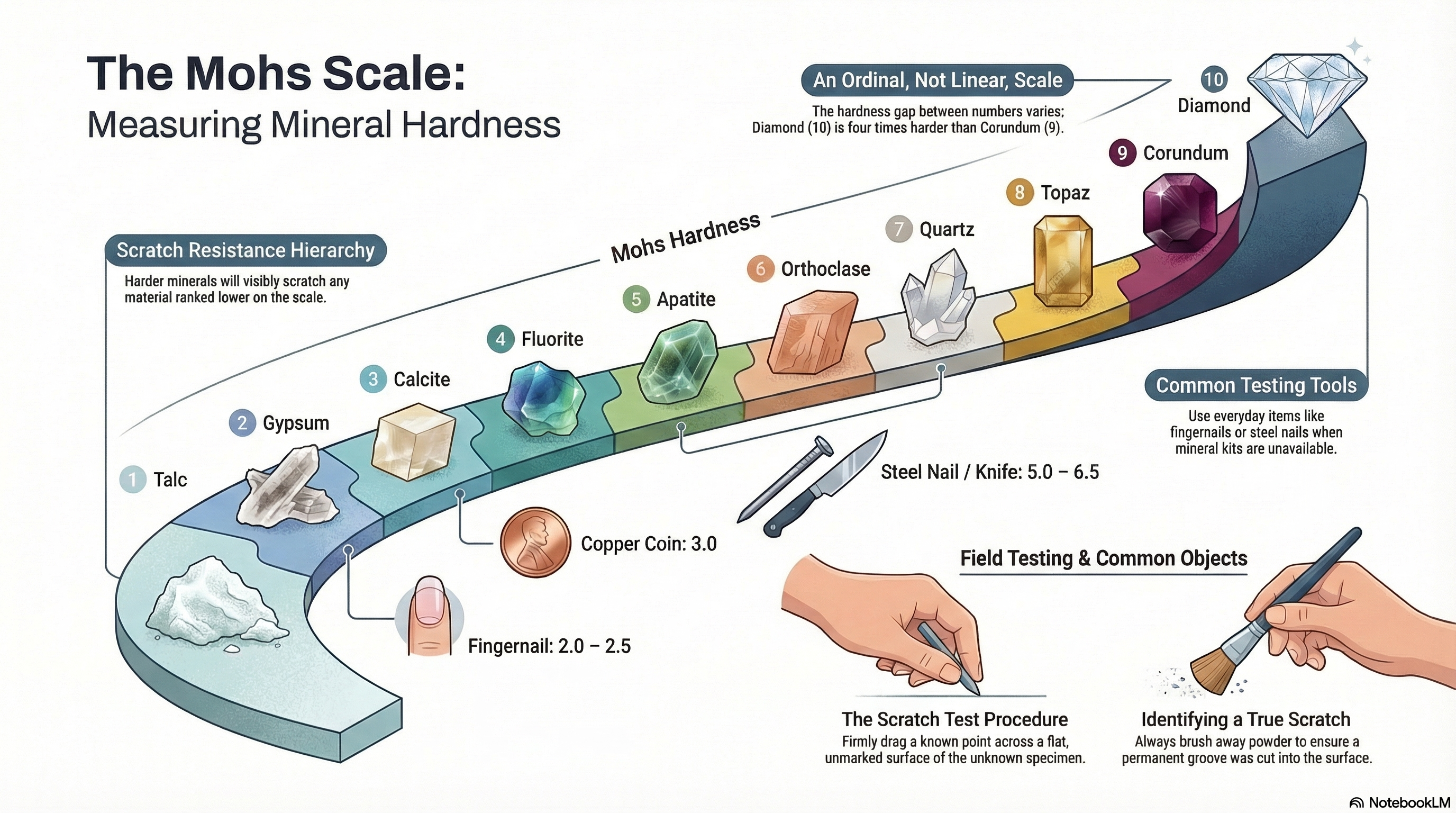
The scale works by comparing the scratch resistance of minerals: a harder material can scratch a softer one, but not the other way around. If a material is scratched by apatite for example, but not by fluorite, its hardness on the Mohs scale would be between 4 and 5.
Each of the ten hardness values is represented by a common reference material, like talc, fluorite, topaz, corundum and diamond.
One important thing to remember is that the Mohs Scale is not linear. The difference between each number is not equal. For example, diamond at 10 is exponentially harder than corundum (sapphire and ruby) at 9. And again, corundum (9) is twice as hard as topaz (8).
The Mohs Hardness Scale
Here is the scale in full:
Why hardness matters in jewellery
Hardness affects how well a gemstone can withstand everyday wear.
Jewellery worn daily – particularly rings – is exposed to knocks, abrasion and contact with hard surfaces. The harder the stone, the better it will resist scratching.
As a general rule:
8–10 – Excellent for everyday wear
7 – Usually suitable for rings but requires care
Below 7 – Better suited to earrings, pendants or occasional wear pieces
That doesn’t mean softer stones shouldn’t be used in jewellery – far from it. They simply require thoughtful design and setting choices.
Hardness vs durability
It’s also important not to confuse hardness with durability.
Hardness refers specifically to scratch resistance, but gemstones can still be brittle or prone to chipping even if they rank highly on the Mohs scale.
For example:
Diamond is extremely hard but can chip if struck at certain angles.
Emerald (Mohs 7.5–8) is reasonably hard but often contains inclusions that make it more delicate.
Opal (Mohs 5.5–6.5) is softer and can be sensitive to knocks and temperature changes.
This is why design, setting and lifestyle all play a role in choosing the right gemstone.
How the Mohs Scale influences jewellery design
When designing jewellery, the hardness of a gemstone helps guide decisions about:
· The type of jewellery the stone is best suited for
· The setting style used to protect it
· How the piece will be worn
For example, a diamond engagement ring may comfortably feature a claw setting, while a softer gemstone may benefit from a rubover or bezel setting to give it more protection.
Likewise, gemstones like opal or pearl may be better suited to earrings or pendants, where they are less exposed to daily knocks.
Choosing the right gemstone for you
Understanding the Mohs Scale doesn’t mean you need to avoid stones you love, it simply helps ensure the design works with the gemstone rather than against it.
With the right setting, care and design approach, even softer stones can become beautiful and wearable jewellery pieces, ready to tell your story.
This is where working with a private jeweller can really help. By considering the gemstone’s hardness alongside your lifestyle and how you plan to wear the piece, it’s possible to create jewellery that is both beautiful and built to last.
Final thoughts
The Mohs Scale is a simple but an incredibly useful tool in the world of gemstones. It helps explain why some stones are better suited to everyday wear than others, and why thoughtful jewellery design matters.
After all, the goal isn’t just to create something beautiful – it’s to create something that can be worn, enjoyed and passed on for years to come.
Related Articles
Do You Know how to Care for your Jewellery?
Do you know the best ways to care for your jewellery and gemstones? Read our handy guide for top tips.
Jewellery Settings & Styles: What’s Right For You?
There is a huge variety of settings, shapes and styles for jewellery so understanding what you like is important.